Economic & Market Perspective: October 2026
Financial markets entered the fourth quarter of 2026 with resilient U.S. economic growth, a cooling labor market and higher interest rates. Consumer spending and business investment continue to support growth, while inflation remains above the Federal Reserve’s 2% target. Higher Treasury yields, elevated energy prices and ongoing geopolitical tensions have also created a more challenging environment. Against this backdrop, we’ll explore what these developments could mean for the markets and economy through year-end and what investors should be watching going forward.
U.S. Consumers Still Resilient
The U.S. economy continued to expand during the third quarter, up from an annual rate of 2.2% in the second quarter, despite higher interest rates and ongoing uncertainty. Consumer spending remained strong while business investment was an important source of economic growth.
Manufacturing activity was solid with the ISM Manufacturing Index remaining in expansionary territory for the ninth consecutive month, with September coming in at 54.5%. (A reading above 50% indicates that the manufacturing sector is expanding.) Overall, economic growth remains resilient, although the sources of growth are becoming increasingly uneven, with AI-related investment providing an important source of strength.
AI Investment Remains a Key Driver of Growth
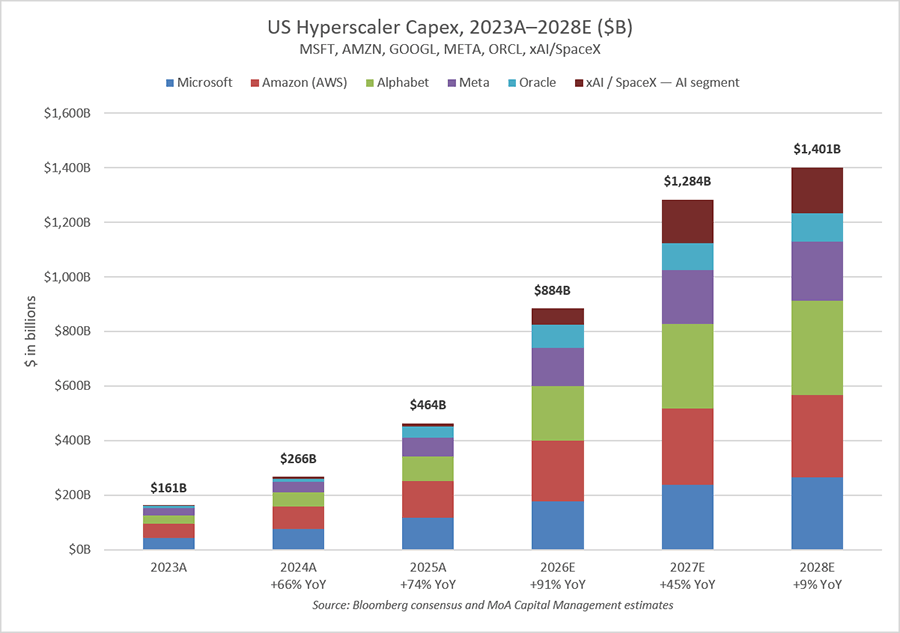
Investment in artificial intelligence (AI) continues to be an important source of business spending. Significant capital is being invested in data centers, semiconductors, power generation and other infrastructure needed to support growing demand for computing capacity. Combined capital spending by major U.S. technology companies is expected to reach approximately $884 billion in 2026, nearly doubling from $464 billion in 2025. Spending is projected to increase further to approximately $1.3 trillion in 2027, reflecting continued investment in AI and data center infrastructure.
The benefits of AI investment are extending beyond technology companies. The buildout of data centers is also creating demand for the power and infrastructure needed to support them. The amount of capital required has also led large technology companies to increasingly use debt to help finance these investments. At the same time, investors are increasingly focused on whether the returns will ultimately justify the amount of capital being spent.
Unemployment and the Labor Market
During September, the labor market continued to cool, with non-farm payrolls increasing by just 29,000 and the unemployment rate edging up to 4.2%. Job growth has slowed considerably, although fewer new jobs are now needed to keep the labor market in balance than in recent years.
The labor force participation rate also increased to 61.8% in September from 61.4% in July—though still below pre-pandemic levels above 63%—as more people entered the labor market. Most of that increase was reflected in higher employment rather than unemployment.
Overall, the labor market has slowed but remains relatively stable, consistent with the current “low-hire, low-fire” environment.
U.S. Consumers Remain Resilient
Consumer spending remained solid during the quarter, despite weak measures of consumer confidence. Consumers remain concerned about inflation and the economic outlook, but those concerns have not yet resulted in a meaningful pullback in spending, with the latest data showing continued strength in consumer spending.
Higher borrowing costs are creating pressure, particularly in the housing market where mortgage rates moved above 7% for the first time this year in September, after sitting close to 6% in February. Higher energy prices are also adding to household expenses.
For the most part, consumers remain resilient, but the experience is increasingly uneven depending on income level. Higher income households continue to benefit from greater savings and gains in financial assets—especially from real estate and financial markets. However, lower income households have been more sensitive to higher prices and borrowing costs, which has led to a greater reliance on credit to purchase essential goods.
Inflation and the Federal Reserve
Inflation remains above the Federal Reserve’s 2% target. Slower wage growth should help reduce some of the inflationary pressure coming from the labor market, but higher energy prices could make further progress more difficult.
The Federal Reserve raised the federal funds target by a quarter percentage point in September to 3.75%–4.00%. Fed Chair Kevin Warsh has moved away from providing forward guidance on the future path of interest rates, emphasizing that future decisions will depend on the economic data.
Recent data increasingly indicate that the Fed may not raise rates at its October meeting. However, upcoming inflation data will be an important factor in determining whether additional tightening is needed later this year.
Interest Rates Move Higher
One of the most significant developments during the third quarter was the sharp rise in long-term interest rates. The 10-year Treasury yield increased more than 80 basis points during the quarter, its largest quarterly increase since 1994.
Earlier in the quarter, higher oil prices and concerns about inflation pushed yields higher. More recently, concerns about the growing federal deficit and government debt have also contributed to the move. As the government borrows more and issues more Treasury debt, investors may demand higher yields to take on the additional supply.
For investors, there are important pros and cons to higher yields. These provide more attractive income opportunities in fixed income, but also increase borrowing costs for consumers and businesses and put pressure on equity valuations.
Market Returns
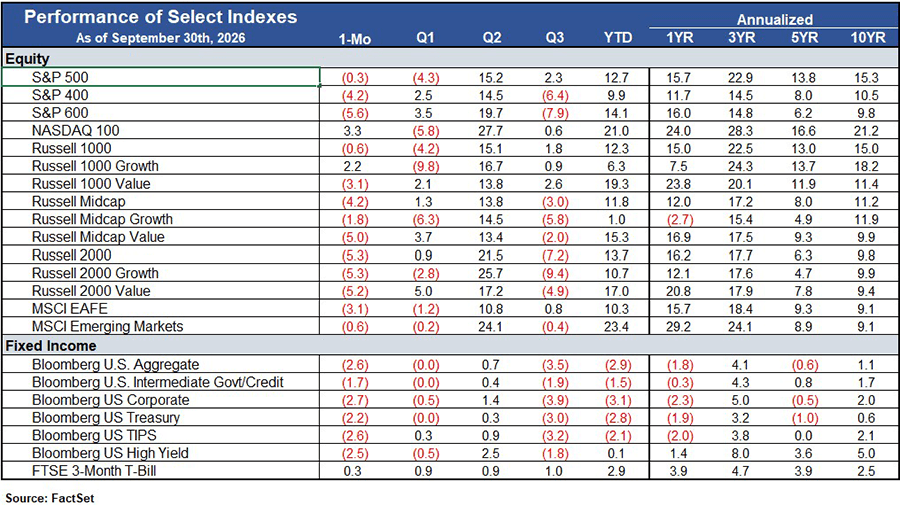
U.S. equity markets continued their positive upward trajectory during the third quarter, although performance weakened in September. The S&P 500 Index® returned 2.3% for the quarter and 12.7% year to date, but declined 0.3% in September.
Small-cap stocks were considerably weaker during the quarter, as rising Treasury yields and higher borrowing costs weighed on more rate-sensitive companies. The Russell 2000 declined 7.2%, including a 5.3% decline in September, but remained up 13.7% year to date.
International markets were mixed during the quarter, the result in part from rising energy and oil prices and persistent inflation. The MSCI EAFE returned 0.8% in U.S. dollar terms during the third quarter and was up 10.3% year to date. Emerging markets were relatively flat during the quarter, but remained one of the strongest areas of the global equity market, up 23.4% year to date. International markets weakened in September, with EAFE declining 3.1%.
Within the S&P 500, performance was uneven across sectors. Information Technology returned 7.2% during the quarter, while Industrials, Utilities and Consumer Discretionary declined.
Fixed income also came under pressure as interest rates moved higher, and the Bloomberg U.S. Agg declined 3.5%.
Earnings Growth
The earnings outlook for U.S. companies remains strong. The S&P 500 is expected to report earnings growth of approximately 27% year over year in the third quarter, following 49% growth in the second quarter.
However, earnings growth remains concentrated, with AI infrastructure companies expected to account for more than half of S&P 500 earnings growth during the quarter.
Earnings estimates also increased during the quarter, even though analysts typically lower estimates as the quarter progresses. Third-quarter earnings estimates increased 10.7% since the end of June, while full-year estimates have increased 16.6% since year-end. Upward revisions have been particularly strong among semiconductor companies and refiners, with Amazon and Alphabet also contributing to the increase in full-year estimates. Recent economic data remain supportive, and earnings revisions have remained positive.
Outlook
The U.S economy enters the fourth quarter of 2026 on relatively solid footing, but the outlook remains uncertain. Robust corporate earnings continue to support equity markets, even as higher interest rates, persistent inflation and geopolitical tensions pose ongoing risks both to equity and fixed-income markets.
Looking ahead, continued economic and financial market resilience will depend largely on whether corporate earnings growth remains strong, and inflation improves enough to reduce pressure on interest rates.
Jamie Zendel is EVP, Head of Quantitative and Asset Allocation Strategies, at Mutual of America Capital Management LLC.
Past performance is no guarantee of future results. The index returns discussed above are for illustrative purposes only and do not represent the performance of any investment or group of investments. Indexes are unmanaged and not subject to fees or expenses. The index returns above reflect the reinvestment of distributions. It is not possible to invest directly in an index.
The views expressed in this article are subject to change at any time based on market and other conditions and should not be construed as a recommendation. This article contains forward-looking statements, which speak only as of the date they were made and involve risks and uncertainties that could cause actual results to differ materially from those expressed herein. Readers are cautioned not to rely on our forward-looking statements.
The information has been provided as a general market commentary only and does not constitute legal, tax, accounting, other professional counsel or investment advice, is not predictive of future performance, and should not be construed as an offer to sell or a solicitation to buy any security or make an offer where otherwise unlawful. The information has been provided without taking into account the investment objective, financial situation or needs of any particular person. Mutual of America is not responsible for any subsequent investment advice given based on the information supplied.
Mutual of America Capital Management LLC is an indirect, wholly owned subsidiary of Mutual of America Life Insurance Company. Insurance products are issued by Mutual of America Life Insurance Company, 320 Park Avenue, New York, NY 10022-6839. Mutual of America Securities LLC, Member FINRA/SIPC distributes securities products. Mutual of America Retirement Services LLC provides administrative and recordkeeping services. Mutual of America Financial Group is the trade name for the companies of Mutual of America Life Insurance Company.