A Closer Look: What Employment Numbers Say (or Don’t) About the Economy
In February, the U.S. economy lost 92,000 jobs instead of creating the 55,000 jobs economists had forecast, according to a recent report by the U.S. Bureau of Labor Statistics. The rate of unemployment increased from 4.32% to 4.44%.
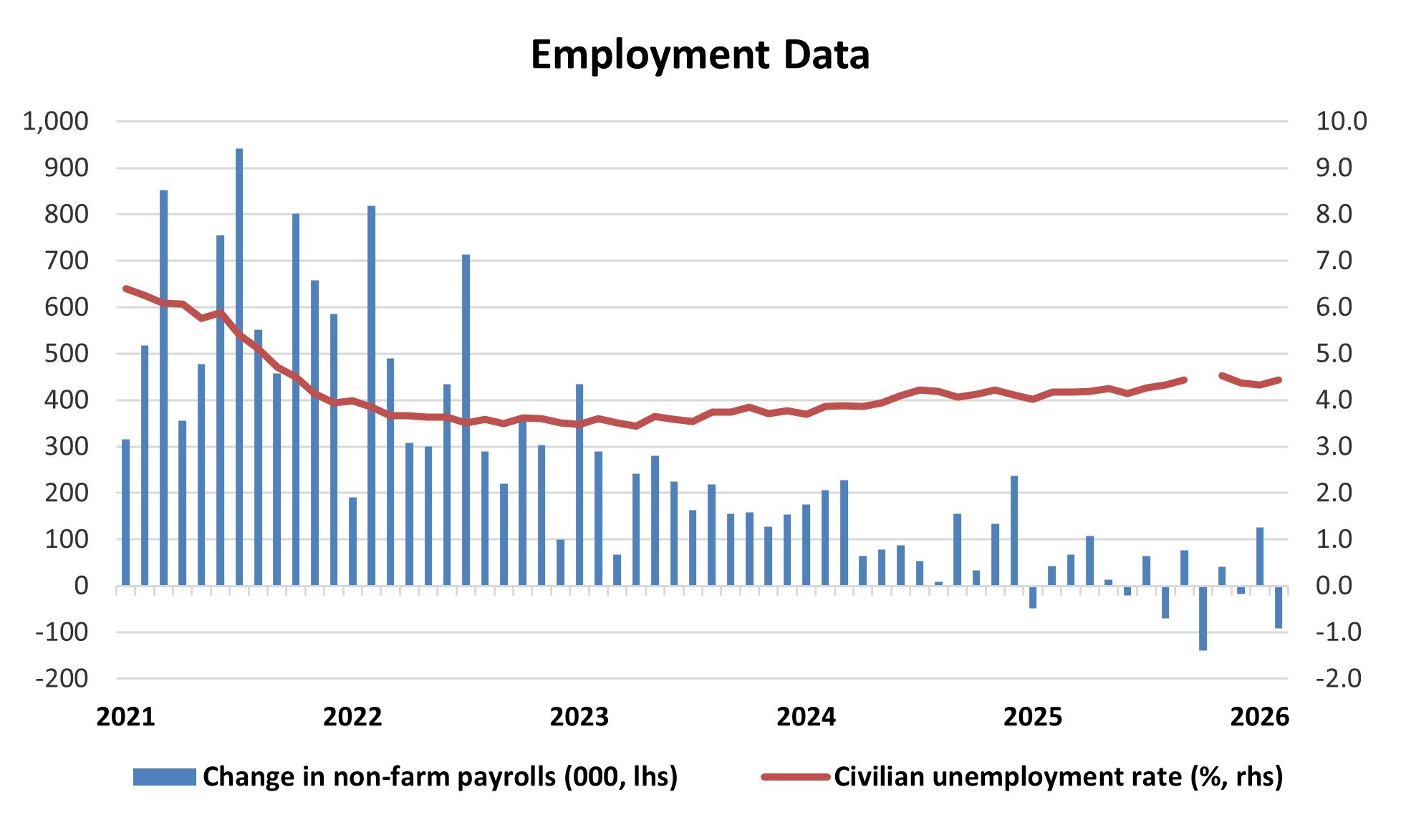
The reaction on Wall Street was swift and significant. The major U.S. equity indices sold off a full percentage point or more in response. But the jobs number contained very little informative value with respect to the strength of the U.S. economy, and did not warrant the ensuing market move. So, what exactly was at play here?
Some Numbers Are Overstated
Looking at the U.S. economy, in February, the total number of nonfarm payrolls—which reflect the number of paid U.S. workers, excluding farm employees, private household employees and non-profit organization volunteers—was 158,466,000. In January, the number was 158,558,000. The difference of 92,000 between the two captured everyone’s attention, and yet that number represents just 0.058% of the more than 158 million. Revisions for December and January added up to 69,000 fewer jobs than previously reported, a miniscule 0.044% of the 158 million. Given these tiny percentages, the 92,000 has no meaningful degree of precision. This is especially evident when considering what has occurred over the past year with respect to the unreliability of surveys, including low and declining response rates, the difficulty of estimating the impact of new business openings and closures on job creation, and changes in post pandemic seasonal patterns.
Another way to look at that 92,000, or any other recent monthly payroll increase or decrease—including January’s better-than-expected jobs numbers reported—is to recognize that it does not provide any insight into the underlying direction of the U.S. economy. It also highlights the guesswork by economists when projecting monthly payroll changes, and helps explain why economic forecasts—including the consensus forecast of February’s employment numbers—often miss the mark.
What Numbers Affect the Economy?
A monthly change in nonfarm payrolls would need to be really high or low—say, one million or more—to be statistically significant or economically meaningful. Such changes would need to be sustained over the course of several months—at least three, but probably more like six. As the chart highlights, for the past nine months, payroll growth has been positive one month and negative the next, and all in small amounts relative to the total number of U.S. payrolls. That’s preferable to an unbroken string of negative numbers, of course, but attributing significance to the actual level of these numbers is not warranted.
All that is not to say that market trading in response to the February jobs data wasn’t real. But it would appear that this particular number simply tapped into investor sentiment that was already predisposed to head lower. If the recent pattern continues, however, March’s employment numbers may well surprise to the upside again.
Jerry H. Tempelman is Vice President, Economic and Fixed Income Research at Mutual of America Capital Management LLC where he is a credit analyst of financial institutions (banks, insurance companies, real estate investment trusts) with the Company. Previously, he was a credit strategist with Moody’s Analytics, and a Senior Financial and Economic Analyst with the Federal Reserve Bank of New York.
The views expressed in this article are subject to change at any time based on market and other conditions and should not be construed as a recommendation. This article contains forward-looking statements, which speak only as of the date they were made and involve risks and uncertainties that could cause actual results to differ materially from those expressed herein. Readers are cautioned not to rely on our forward-looking statements.
The information has been provided as a general market commentary only and does not constitute legal, tax, accounting, other professional counsel or investment advice, is not predictive of future performance, and should not be construed as an offer to sell or a solicitation to buy any security or make an offer where otherwise unlawful. The information has been provided without taking into account the investment objective, financial situation or needs of any particular person. Mutual of America is not responsible for any subsequent investment advice given based on the information supplied.
Mutual of America Capital Management LLC is an indirect, wholly owned subsidiary of Mutual of America Life Insurance Company. Insurance products are issued by Mutual of America Life Insurance Company, 320 Park Avenue, New York, NY 10022-6839. Mutual of America Securities LLC, Member FINRA/SIPC distributes securities products. Mutual of America Retirement Services LLC provides administrative and recordkeeping services. Mutual of America Financial Group is the trade name for the companies of Mutual of America Life Insurance Company.