A Closer Look: Jobs Numbers Reveal More Than Meets the Eye
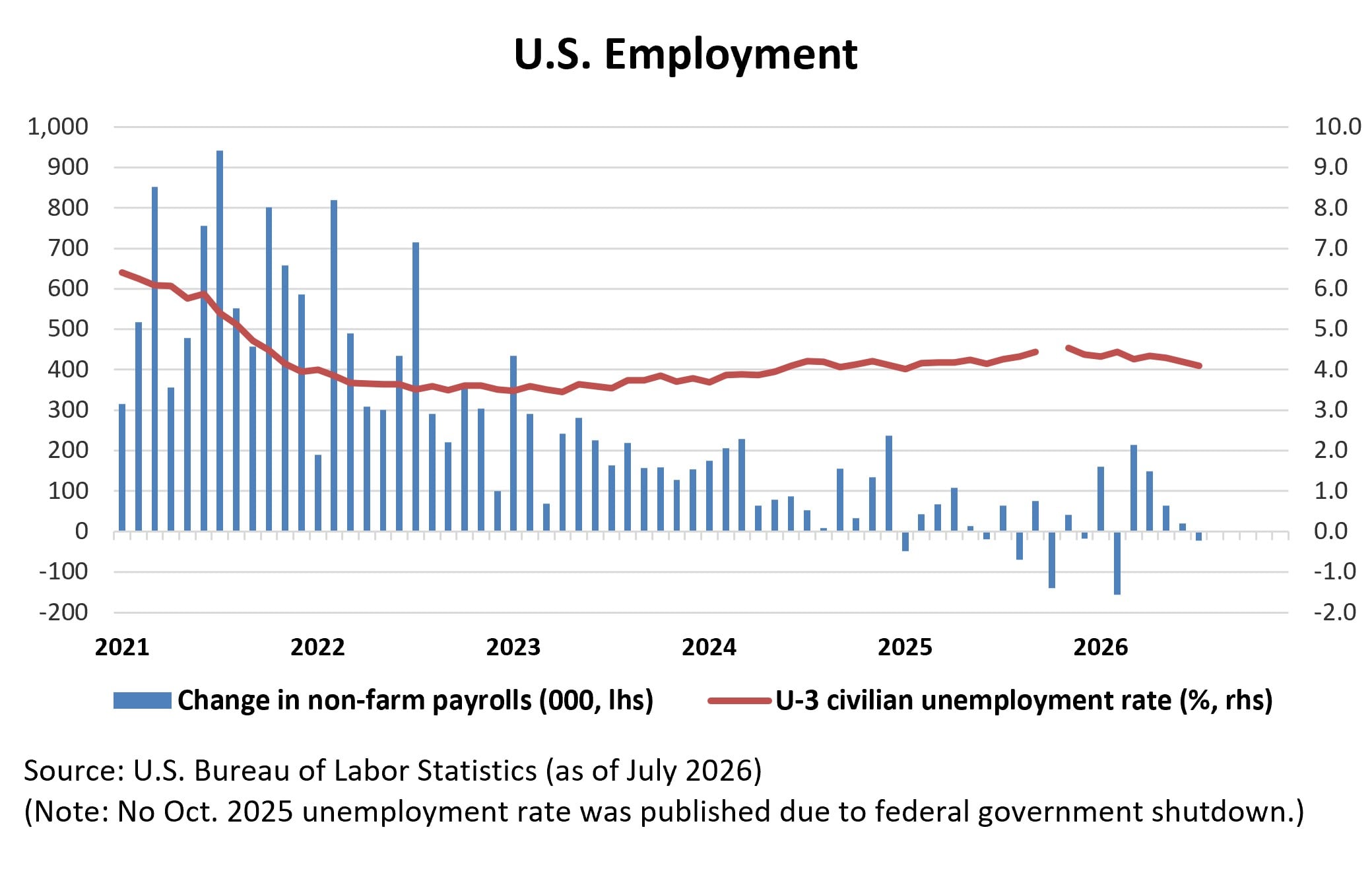
The July employment report was a mixed bag, seemingly contradictory in nature. Net nonfarm payrolls fell by 23,000, the first monthly decline in six months. And yet, the unemployment rate also fell, from 4.19 percent in June to 4.09 percent in July—the lowest level since January 2025, and down from 4.54 percent last November.
In general, news commentary focused on the negative net nonfarm jobs number, and suggested the labor market was deteriorating. The drop in the unemployment rate was generally dismissed as reflecting a decline in the size of the labor force. However, we believe the decline in the unemployment rate is a positive, while the net decline in jobs is not nearly as meaningful as it used to be.
Nonfarm Payroll Influence Diminishing?
Economists have traditionally attributed greater importance to the nonfarm payroll number than to the unemployment rate. The Bureau of Labor Statistics bases the former on a survey of businesses and other establishments, and the latter on a survey of households. The former is considered more accurate, hence the greater significance economists place on it.
This may no longer hold, though. As we noted in our March issue of A Closer Look, given that the total number of nonfarm payrolls in the United States is almost 159 million, a net decrease of 23,000 is so tiny that it lacks any meaningful degree of precision. The monthly change would need to be much greater, in either direction, and would need to be sustained for many more months to give a clear indication about the direction of the labor market and the economy.
Additional Data Provide Insights
In addition, the monthly employment report—which contains many more data than the nonfarm payroll total and unemployment rate—contained the following information in July, also suggesting the labor market is in better shape than indicated by some news headlines:
- Jobs in the private sector were up, and have increased for five consecutive months, indicating that U.S. employers are not reluctant to hire new workers. Much of the decline in workers was in state and local government jobs.
- The drop in the unemployment rate was widely attributed to two categories of people leaving the labor force: foreign-born workers and baby boomer retirees. But this is a decline in the supply of workers rather than in the demand for them. Although a stagnant or declining population limits how fast an economy can grow, an unemployment problem is a different issue altogether. In July, the number of people filing unemployment claims in the U.S. dropped for the third straight month, and at 6.9 million people is now down from 7.6 million in February.
- Nonfarm payroll growth for April and May were both revised down but remained positive, at 63,000 and 20,000, respectively. It’s also worth noting that the number of new workers for whom the economy needs to create new jobs is down substantially from a generation ago, when the overall population was growing at a faster clip than today.
- The average duration of unemployment fell for the second month in a row, from 26.0 weeks in May, to 25.5 weeks in June, to 24.9 weeks in July.
- The ratio of job openings per unemployed worker has ticked up this year, from 0.87 last December to 1.04 as of July.
For the U.S. Federal Reserve, which weighs the employment picture against inflation in setting short-term interest rates, subdued jobs growth can sometimes be a positive in that it means the labor market is not a source of inflation. With this in mind, in response to the July employment numbers, federal funds futures markets lowered the implied probability of a rate hike in the Fed’s September meeting. The Fed’s actual September decision, however, is likely to be determined by inflation and employment data released between now and then.
Jerry H. Tempelman is Vice President, Economic and Fixed Income Research at Mutual of America Capital Management LLC where he is a credit analyst of financial institutions (banks, insurance companies, real estate investment trusts) with the Company. Previously, he was a credit strategist with Moody’s Analytics, and a Senior Financial and Economic Analyst with the Federal Reserve Bank of New York.
The views expressed in this article are subject to change at any time based on market and other conditions and should not be construed as a recommendation. This article contains forward-looking statements, which speak only as of the date they were made and involve risks and uncertainties that could cause actual results to differ materially from those expressed herein. Readers are cautioned not to rely on our forward-looking statements.
The information has been provided as a general market commentary only and does not constitute legal, tax, accounting, other professional counsel or investment advice, is not predictive of future performance, and should not be construed as an offer to sell or a solicitation to buy any security or make an offer where otherwise unlawful. The information has been provided without taking into account the investment objective, financial situation or needs of any particular person. Mutual of America is not responsible for any subsequent investment advice given based on the information supplied.
Mutual of America Capital Management LLC is an indirect, wholly owned subsidiary of Mutual of America Life Insurance Company. Insurance products are issued by Mutual of America Life Insurance Company, 320 Park Avenue, New York, NY 10022-6839. Mutual of America Securities LLC, Member FINRA/SIPC distributes securities products. Mutual of America Retirement Services LLC provides administrative and recordkeeping services. Mutual of America Financial Group is the trade name for the companies of Mutual of America Life Insurance Company.